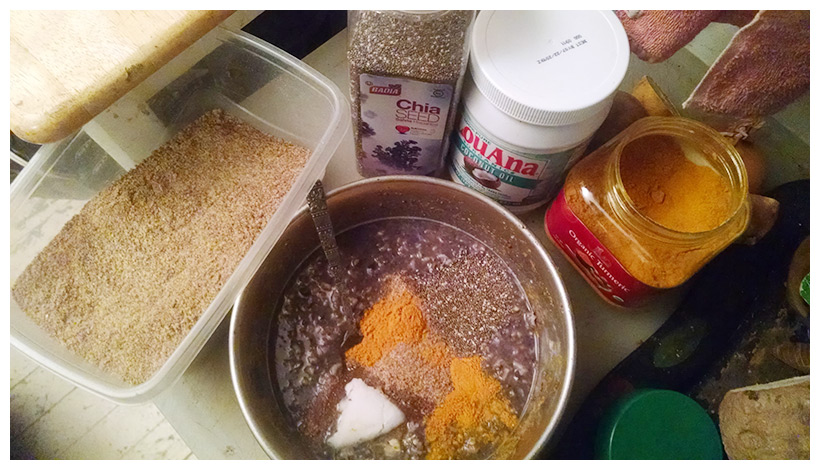
This is a meal of brown rice, mashed black beans, chicken meat, chicken stock,
ground flax seed, chia seed, coconut oil and turmeric.
The Foundation Diet for Dogs |
832 Reads |
This is a meal of brown rice, mashed black beans, chicken meat, chicken stock, ground flax seed, chia seed, coconut oil and turmeric. |
||
Disclaimer & Terms of Use
I'm not a veterinarian, I'm not a doctor, don't believe anything I say.
If your dog is sick, it's possible nothing you do will save it and changing your dogs diet suddenly could make the problem worse.
By using this website and the information it contains, you agree to do so at your own risk, to educate yourself, do your own research and take personal responsibility for what you feed your pet.
I'm not recommending anything to anyone, I'm sharing my own beliefs, research and experience. This diet is more art than science and as such, everything mentioned here should be treated as questionable, suspect and wrong.
The concepts here aren't unknown or new so I can't take credit for them. Writing it down though has served to highlight for me how much I don't know so again, don't believe anything you read here.
This document is a work in progress and is incomplete. I will be modifying it, changing it, and adding to it.
Feel free to copy, paste, and share.
Before you attempt to cook for your dog...
READ HERE TO UNDERSTAND WHAT FOODS AND INGREDIENTS ARE POISONOUS TO DOGS.

I always do this...
1. Avoid changing a dogs diet too quickly. Add in the new food and phase out the old food over a few days or a week to avoid shocking the dogs system.
2. When starting a dog on a new diet, I vary the dogs diet within the framework of what I feed so I can find out what the dog likes and doesn't like. I've found that when I'm getting it right, my dog shows me in his energy level and his overall appearance of health. It's not something you can measure, it's more related to your gut instinct about how your dog is feeling based on your own experience.
3. The foundation of the each meal should be the basics, proteins, vegetables, fillers and fats. Every meal should contain those building blocks.
4. I mention a few supplements and I feed them sparingly at first so I can find out if the dog is sensitive to any of them. Some of these supplements have medicinal qualities and can have side effects, or negatively impact the health of a sick dog.
5. Even if the dog isn't sensitive to any of them, I avoid feeding any single supplement or food every day for an extended period of time. Repetition is antithesis to the philosophy of this diet. Too much of a good thing is still too much and even drinking too much water can kill you.
6. While I tend to feed certain things over and over again, like brown rice, chicken stock and certain vegetables and proteins, it's important to provide as much variety as possible within those basic elements so the dog gets access to a variety of flavors, textures and nutrients.
The Premise
Based on my experience nursing multiple dogs through illnesses mostly prevalent during old age, including cancer, joint disorders, nervous system disorders and kidney failure, I've come to the conclusion that processed, dry dog food negatively impacts dog's immune systems over the long term and shortens their lifespan. I believe it contributes to, if not outright causes many of the diseases common in dogs.
All of my evidence is anecdotal, but I've been able to reproduce positive results using this diet with 3 elderly and sick dogs over 20 years by taking them completely off of processed dog food and switching to a real food diet based on simple ingredients and preparation methods.
"The Foundation Diet" is a name I came up with. I call it that because I believe it provides a foundation for healing and cellular repair.
In holistic circles, "natural" is a common buzz word. In this diet, it's more accurate to use the term "real" food. Processed dog food is a facsimile of food. The food in this diet is just food. Chicken is food. Beef is food. Vegetables are food. Is artificial, processed dog food a food? It's something like a food, but I think that if your definition of food includes the goal to achieve the best health for your dog, the best answer is no.
My dogs ate processed dog food for most of their lives. Some dog foods are better than others. Some dog foods are safer than others. The best argument in favor of processed dog food is that millions of dogs live happy, more or less healthy lives for many years eating it.
Dogs can live many years eating processed dog food but that doesn't mean they're living the best life they could. Processed dog food is manufactured under less strict standards than human food so it's hard to know exactly what's in it and what long term effect the ingredients have on the health and lifespan of our pets. Because of the lower standards, industries use it as a dumping ground and profit opportunity to unload ingredients which can't be fed to humans. This also applies to the chemicals, additives and preservatives used in dry dog food. Some ingredients and additives deemed too dangerous for human consumption are regularly used in animal feed.
The animal feed industry uses ingredients that can't legally be fed to humans. Dog foods can and do contain large amounts of pesticides, dyes, preservatives and other chemicals. Heat destroys nutritional value, and once wet food meal is cooked at high temperatures for preservation purposes, some of the nutritional value of the ingredients is degraded.
I've seen over and over again younger dogs that seem fine eating processed food, but as they age, they develop diseases like cancer, allergies, obesity,
diabetes, joint disorders and many others. The one trait these diseases seem to have in common is inflammation. As dogs grow older, their immune systems weaken and they become more suceptible to these problems. Is the inflammation part of the normal aging process or is the process being accelerated because they're eating an unnatural food?
I believe the latter to be true. No matter how noble the manufacturers motives, no matter how much thought, science and planning is put into the development of a dry dog food, no single food, especially cooked, dry food, can be healthy for a complex organism as a sole source of nutrition.
On a molecular level, real foods contain a multitude of enzymes, vitamins, minerals and other components which current science may not yet understand the value of. The dog food industry tries to create a food immune to spoilage and because of this works within a limited framework.
The experiences I've shared below have led me to believe these elderly dogs were suffering from widespread inflammation caused by long term exposure to unknown properties of processed dog food, possible nutritional deficiencies, possible low grade allergies and possible
carcinogens and irritants present in chemicals, dyes, preservatives and pesticides the food contains. This happens over many years of feeding processed food which has the effect of degrading the immune system of the dog until it reaches a critical state and develops a life threatening disease.
Most of us spend literally seconds each day feeding our dogs. That's the beauty of dry dog food, it's convenient. There's an unspoken prevailing narrative that exists in our culture, that feeding dog food is "normal" and good. The narrative isn't exactly wrong, but it's not exactly right either.
I didn't learn what I'm writing here so I could be a better dog parent than someone else, I did it because I wanted my dogs to live longer and healthier lives. When the vet tells you there's nothing else they can do and all you can do is make the dog comfortable until they die, what other choice do you have? There are millions of pages, both printed and on the internet devoted to human nutrition. Why then, is it so hard to find information on what's healthy for dogs to eat? It's because we buy the narrative that's been sold to us that says there's no other way. It's because the pet food industry is worth billions every year. That narrative exists because they created it, and because in our fast food culture, we've been programmed to believe that asking our dogs to eat one thing their entire life is normal.
I believe this diet works not just because it adds unprocessed nutrients and other substances required to sustain life, but also removes the irritating factor, the dog food itself. Even if you discount the possibility of detrimental ingredients and properties being present in the food, the idea that a complex organism can not only survive but thrive on a "one size fits all" form of fast food designed not for their optimal health, but for our convenience seems like a fanciful and self-serving form of science.
In the name of full disclosure, I still feed my dog processed food when I have to.
This diet isn't a panacea. It wont fix every problem or illness. Like us, dogs are born with genetic variations which can make them more or less prone to certain diseases.
My Experience: How this diet made an inoperable tumor disappear
Rocky was a 13 year old male Jack Russell Mix who suffered recurrent cancer growth which manifested as lumps growing under the skin (documented through biopsy) and a late life bout of tick paralysis. Mickey was a 14 year old female with a blood disorder (Heinz Body Anemia) caused by garlic consumption. Lucy was a 14.5 year old female who had lost the ability to stand without assistance and was suffering from Kidney failure (documented by lab tests).
 |
 |
 |
||||
In all 3 cases, I stopped feeding them processed dog food completely and switched them to the diet documented here. Each of them gained strength, displayed a reduction in symptoms of disease and lived longer than I was told they should.
Rocky, the Jack Russell Terrier Mix, had endured multiple surgeries to remove cancerous growths under his skin. These growths ranged in size from about 1 - 5 centimeters. With each surgery, he grew weaker, and this compounded weakness still present from his ongoing recovery from tick paralysis.
The surgeries were successful in Rocky's case but even before he had healed from his final surgery, the largest tumor yet began to grow next to his spine in the middle of his back. This tumor was embedded in the muscles and nerves next to the spine and was inoperable. Even if it had been operable, I wouldn't have given him the surgery because of the toll repeated surgeries had taken on him.
Removing processed food and switching him to real food had an immediate and positive effect. The large tumor on his back was oval shaped, about 7 centimeters long and 2 centimeters high. Within days of removing processed dog food from his diet the tumor began to shrink. Within six weeks it disappeared completely leaving a slightly concave, mostly hairless and leathery patch of skin where the tumor had been.
Lucy was over 14 years old when I switched her to this diet after the vet diagnosed her with kidney failure. I had taken her to the vet to get her teeth cleaned where they performed blood work to ensure she was healthy enough to undergo anesthesia. The vet told me they couldn't do the procedure after the blood work revealed the problem with her kidneys.
Before this, I had noticed a significant reduction in her strength. She was unable to get up from a laying position without help. She could no longer jump on the bed, even though the bed was fairly low and it had always been easy for her. She was also drinking a ton of water.
I decided to feed her this diet as a last ditch effort to see if I could improve her health and extend her life. At that point her quality of life was so degraded that neither of us had much to lose by trying.
I stopped feeding her processed dog food completely and began feeding her this diet. Within days she could stand wihtout help and jump on the bed again. I then started taking her to the dog park and allowed her to walk as much as she wanted to, which was generally about 1/2 mile per day. She began to bark again, which she hadn't done much of for years. We did this every day for the rest of her life.
After I took her off of processed dog food, her water consumption decreased dramatically (EXCLAMATION POINT, Seriously) Where before I had to fill her water bowl every couple of days, she now drank so little water that I had to dump it out and clean the bowl before it needed refilling.
One event stood out to me as defining the value of this diet for her. After six months of her being on the real food diet, I was forced to feed her processed food again when money was tight. I still had a bag of the expensive dog food so I fed it to her. By the 3rd day, she again lost her strength, couldn't stand on her own or jump on the bed and seemed to be in pain.
This, more than anything was proof of concept of the value of this diet and the detrimental effect commercial dog food had on her. After being diagnosed with kidney failure and switching to this diet, her health improved dramatically. Her energy exploded, she went from bed-ridden to walking and jumping but after only 3 days of switching back to processed dog food she once again became disabled. Not only did dry dog food seem to be inadequate, it seemed to work against her health.
Lucy lived another full year after being diagnosed with kidney failure and it was a good year. She barked, she ran, she jumped, she had fun. She wasn't sick and hurting. I believe that if I hadn't taken her off of the expensive dog food, she would have died soon after her diagnosis and I believe processed dog food caused the kidney failure. Once she was taken off of it, her kidneys recovered. There's no way she lived another full year with non-functional kidneys. When processed dog food was removed from the equation, her water consumption immediately dropped to a fraction of what it had been and she regained most of her strength and flexibility. The way I see it, this diet gave me another year with her and for that I'm grateful.
Lucy was diagnosed with kidney failure in October 2016. This is her in March, 2017, 5 1/2 months after being taken off of dry dog food and being put on this diet.
The Diet
The Foundation Diet for Dogs is a simple diet that's easy to prepare and maintain, doesn't cost a lot and is made up of simple ingredients readily available at most grocery stores.
It's a combination of meat, dairy and vegetable proteins, oils, fats, additives, supplements, vegetables and fruits.
Many of the meals are made using simple, easy to follow recipes which can be pre-cooked, cooked for immediate use or cooked, portioned and frozen.
Any cooking method you would use to cook human food can be used to cook the meals, including making soups, sautee, crock pot, boiling and stir-fry.
This diet is easy to follow once you get the hang of it and doesn't take a lot of time or cost much more than feeding conventional dog food. Actually, depending on the quality and cost of the dog food you feed, it might be cheaper.
The first thing a dog does when approaching a dish of food is give it the smell test. If the food doesn't pass the smell test, the dog wont eat the food. That's why all of the meals I've devised for my animals are designed to overwhelmingly give off the smell of the fat and meat. The meat (or protein) provides the smell and flavor and the addition of chicken stock provides even more. Heating the meal slightly before serving enhances the smell.
Most people believe their dogs wont eat vegetables but I've found that to be the exception, not the rule. Given the opportunity, most dogs will try to eat amost anything that seems like food. I believe your average dog has a wide variety of tastes but they're never explored because they're never introduced to it.
Certain ingredients, the vegetables and greens, fats and fiber provide variety in nutrients and while it may seem these aren't ingredients dogs would normally eat, from what I understand that isn't necessarily true. I've found that if you mix the vegetables and other ingredients with the fat rich proteins and chicken broth, you can include almost anything in the meal.
This diet is designed to (hopefully) provide a balance of the following.
1. Essential Fats
2. Proteins
3. Fiber
4. Carbohydrates
I've talked with a lot of people about this diet and I've met some skepticism. The results I've seen using these feeding methods with 3 sick dogs over 20 years are their own proof. I understand what happened, what I did, and what the effects were. In all three cases, the dogs experienced a marked increase in energy and apparent overall health. All 3 dogs were in a state where I was told there was nothing that could be done for them other than palliative care and all 3 dogs showed elimination or reduction of symptoms including the shrinking and disappearance of a cancerous tumor.
Anecdotal information however is not a double blind study. Pharmaceutical, veterinary and dog food industries have no incentive to study animal nutrition outside studies done to promote the sale of laboratory designed and factory produced food. Dog Food production is largely unregulated and the only assurance you have that even the most expensive dog food is high quality and nutritionally complete is the word of the company making the food.
I think the most important thing is to experiment and see what works best for you and your dog.
There's a lot of information on the net from many reputable sources and some of it is conflicting. Once again, do your own research and come up with a feeding routine that works for you and your dog.
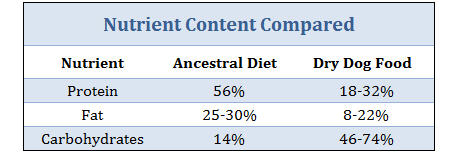
Source: Dog Food Advisor
The Myth: Human food is bad for dogs
This isn't true. Some human food is bad for dogs, but clean, real food, the kind that is healthy for you is generally good for your dog and better than artificial dog food.
Poisons: Things you can't feed your dog
This is NOT a complete list. Check here for a more complete list of what "Not" to feed your dog.
1. Any type of onion or garlic. Onions and garlic will kill your dog.
2. Chocolate. Chocolate has an amphetamine like effect in dogs.
3. Grapes or Raisins. In large amounts can cause kidney failure.
4. Avocadoes
5. Raw Potatoes
6. Tomatoes
7. XYLITOL - An artifical sweetner sometimes found in processed yogurt. Xylitol is poisonous to dogs.
Xylitol, a 5-carbon sugar alcohol used as a sweetener. When ingested by dogs, xylitol may cause vomiting, loss of coordination, seizures, and in severe cases, liver failure.
While we do share much of the same DNA, we are not the same as our pets and some things we can eat, they can't. Some of the things we can eat are deadly to dogs, especially Onions and Garlic.
How often do I feed with this diet?
That's up to you and your dog. I've found that my dogs generally require at least two meals per day with this diet. Because of the higher water content than dried food, it seems to digest faster. My dogs have all been happy eating two of these meals per day.
This diet has never made my dogs sick
None of my dogs have ever gotten sick from this diet. There's been no diarrhea, no stomach upset, no vomiting. There's always the chance that you could feed something to your dog that it's allergic to. This is outside of my experience and I suggest that if you run into this problem, stop the diet immediately and consult a veterinarian. Some dogs are very prone to allergies but I think processed dog food is much more likely to cause allergies than real food.
I have however seen dogs revert almost immediately back to a weakened and sick state if for some reason I switched them back to artificial dog food. As I said before though, this is not an exact science and I'm not a doctor or scientist. This is largely unexplored territory, and if you're going to try this you have to do your own research and gain your own experience. As with me, you might be tempted to try this diet with a very sick dog who already has a diagnosis of a life threatening illness. Unfortunately, some problems can't be fixed with nutrition alone and no matter what you do, the dog will still die. That doesn't mean you shouldn't try. In all 3 of my cases, it was a last ditch effort before having the dog put down. If your dog is very sick it might be worth a try, but only you can make that decision. For myself, I've decided that I will always (in the future) euthanize my dog sooner rather than later. I've watched 3 of my dogs die because I waited too long, and made a committment to myself not do it again. Speaking generally, if the diet is going to have a positive impact on the well being and health of your dog, you will see results very quickly after starting the diet, usually within 3 or 4 days, but in the case of my dog Rocky, it took 6 weeks of feeding this diet and not feeding any processed dog food for his tumor to disappear.
The Keys to Palatability
To ensure the food you make is palatable to your dog, there are a some points you should take into consideration.
1. Consistency - I find that this matters. As with people, it seems that dogs like their food to be of a certain consistency, not too hard, not too soft with a certain amount of crunchiness and liquid. I generally try to create meals which have the consistency of canned dog food. I do this by adding more or less ground flax seed, brown rice and chia seed. All of these ingredients contain fiber, and absorb liquid.
2. Aroma - This is especially true of dogs. We all know they have a much stronger sense of smell than we do. The one aroma which helps more than anything, is the smell of animal fat and meat. That's why chicken stock is such a central part of the meals I make.
3. Taste - Like people, every dog is different. They like some foods and some they don't. If they decide they don't like something, and refuse to eat it, I try to identify what it is, then eliminate it completely. With Lucy, I once mixed in too much turmeric, and she didn't like the taste. She wouldn't eat the meal no matter how much chicken stock I added and from then on, I used less and she resumed eating the meals.
4. Temperature - My dogs have generally liked their food to be warm. In this, they seem to be like us. They will eat cold food if they're hungry, but they always seem to enjoy it more when it's warmed, but not hot. I heat my food in the microwave for about a minute and always check to make sure it's not too hot. I think again, this is because heating releases the aroma in the fats and meat, which makes the food much more attractive to the dog.
Fillers
I use a number of fillers in most meals. These are generally easy on the digestive system and are whole foods which can be fed often and over long time periods. I tend to mix and match though to keep the food interesting for the dog. Some of them I use to provide liquidity to a meal (like almond milk) if the food is too dry. Here they are in no particular order.
1. Brown Rice - Learn More - This is the heavy hitter filler ingredient. It's high in fiber, minerals and vitamin b3. It's convenient, cheap and easy to use. I keep it in the fridge, ready to go and add it to a lot of meals.
2. Flax Seed Meal (Ground Flax Seed) - Learn More - Flax seed is high in plant based omega oils, and ground flax seed is a great source of fiber. I add this to every meal. I generally add about a tablespoon to a meal for my 35 pound dog. For larger dogs, add more. In meals where you add ground flax seed, add enough liquid to soak into the flax meal, otherwise the food will be dry and hard to swallow. Wal-Mart sells 1 pound bags of organic ground flax seed under the Great Value Brand.
3. Chicken Broth, Low Salt, Organic - Learn More - This is relatively inexpensive, easy to store, and is sold in boxes at Wal Mart which don't require refrigeration until they're opened. I add this to most meals, unless the meal contains a lot of meat. Chicken broth is what adds palatability to the meals, because when you heat it for a minute or minute and a half in the microwave, it gives off the aroma of meat, which your dog will love. You don't have to buy chicken broth, you can make your own. I often buy the rotisserie chickens pre-cooked. Once all the meat is eaten, I put the carcass in about 2 gallons of water, and cook until the bones and flesh fall apart. Once that's done, strain out the liquid, pick out the larger leftover pieces of meat, throw that back in with the liquid, and freeze the broth for later use.
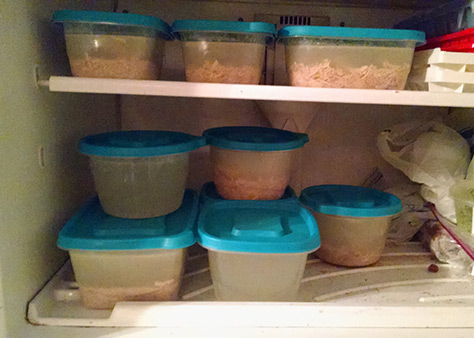 |
The best way to save money and stock up on chicken stock is to make your own. In this case, I made almost 3 gallons of chicken stock for $7.76. This is the part I froze for later use. Finally, I strain out all of the meat and bones, and pick out the bones by hand and throw them away. I include all of the cartilage with the meat. I cover the bottom of the containers with meat, fill halfway with stock, and then fill the rest of the way with more water, cutting the stock around 50%. This extends the stock, but it's so dense after boiling that it's perfect for feeding once it's cut. |
|
4. Chia Seeds - Learn More - Are a great source of Omega 3, 6 and 9 fatty acids, are rich in B Vitamins and contain a lot of fiber.
5. Almond Milk (Unsweetened, Organic) - Learn More - I find Almond Milk to be a great mixer when a meal is drier than I want it to be. My dog loves the taste (or maybe just doesn't hate it). Some websites state that dog's can't easily digest almond milk. I feed it and haven't noticed any problems, and use it intermittently and sparingly. I'm not a doctor or a vet though, so don't believe me.
Supplements
WARNING - Feeding supplements such as these could kill a sick dog or a dog that's allergic to them. I always use caution and never feed anything new to a dog in large quantities. I always test using small amounts. I've fed these supplements to my dogs successfully for years, but every dog is different, and what works fine for one dog may make another sick. Even if these supplements cause no problems, I don't feed any supplement in excess, in every meal or for long periods of time. Some of these supplements like Alfalfa Juice Powder and Turmeric have medicinal qualities and should be fed with care and discretion only after you're fully comfortable that you understand their properties and possible side effects.
1. Brewers Yeast - Learn More - Of all the supplements you can give your dog, Brewers Yeast might be the most valuable. It has a wide range of B Vitamins, Minerals, is good for almost every system in the body. It promotes regulation of blood sugar, is good for the eye sight, and there's some evidence that it might help repeal fleas. I always add brewers yeast to my dogs meal AFTER heating it, so it isn't heated in the microwave.
2. Nutritional Yeast - Learn More - Nutritional yeast and brewer's yeast are similar, although brewer's yeast contains chromium, where nutritional yeast does not.
3. Turmeric - Learn More - If you believe Dr. Internet, Turmeric is capable of curing anything from baldness to nearsightedness. From my own personal experience, I have grown to believe that it's very effective as a preventative measure. Rather than going into the myriad qualities attributed to this herb, I'll just say that I use it in every meal (more or less), and I firmly believe it has some very heatlhy qualities. A few of the proven benefits are cardiovascular and cancer preventative. If you have questions about it, please Google it. I buy organic Turmeric powder in 1 pound containers from Amazon.com. I put about 1 teaspoon of Turmeric in each meal I make for my 35 pound dog. You have to be careful feeding Turmeric though, because it's bitter, and if you overfeed it, your dog might reject the meal.
4. Vitamin C - Learn More - Most people don't think about giving vitamin C to their dog. From everything I've read, Vitamin C might be the most important nutrient for the prevention and treatment of cancer. I don't add it to my dogs meals, but I wrap it in cheese and give it separately. I give 100 MG, a couple of times a week. It isn't absorbed easily and a lot of it winds up being passed in the dogs urine. Vitamin C is easily destroyed by heat, isn't easily absorbed, and I doubt the quality and availability of Vitamin C in heat treated commercial dog food. If you research Vitamin C supplementation in dogs, you'll find a lot of confilcting information. Some dogs are genetically prone to forming kidney stones and adding vitamin C to their diet, may increase the chances of their forming a stone. Because of this, check if your dog is one of those breeds before you make the decision to supplement your dogs diet with Vitamin C. I give vitamin C to my dogs, but most vets will probably tell you they don't need it. I've done a lot of reading on this subject and the results have been confusing to say the least. I'll end this by saying that I believe it's helpful and that dogs don't get enough. For this reason, i supplement it on a semi-regular basis. Over-feeding vitamin C can cause diarrhea.
5. Seaweed Powders - Learn More - These include Chlorella, Bladderwrack, Dulse, Irish Moss and Kelp powders and are available from health food stores and on Amazon.com. Seaweed Powders are generally about 25% protein and 2% fat. They're rich in lycopene, carotene, vitamins, minerals and are considered one of the richest sources of minerals and amino acids found in a plant source. They're considered phytonutrients and whole food which can be fed daily. They're easy to digest and low in salt. They contain iodine which can benefit dogs that suffer from hypothyroidism. It's believed they help with vision and skin problems and hair loss, help to balance the metabolism and bind with and remove heavy metals They're believed to help with cardiac conditions and diabetes. There have also been some studies that suggest they help with cancer prevention and tumor reduction.
6. Alfalfa Juice Powder - Learn More - Nutrient dense, low in calories, fat and sugar. It's high in vitamin C, vitamin K, magnesium and thiamine. It's believed to help with arthritis, diabetes and some bleeding disorders. It's high in vitamin K and because of this is a blood coagulant that may cause problems in dogs with blood disorders like anemia. It may cause nausea or gastritis in some dogs.
Note: When you purchase supplements, always check the country of origin. I avoid supplements produced in China because of their history of producing adulterated products.
Fats and Oils (Essential Fatty Acids or EFA's)
This article is a great summation of fat requirements for your dog. They say that calories from fat should make up about 15% of your dogs diet.
As you noticed in the list above I use a variety of oils in the meals that I make for my dogs. These include Flax, Hemp, Coconut and Olive Oils. One of the problems with this diet is that it's as much art as it is science. Thousands of studies have been done on the effects of various fats on human health but this isn't true for dogs. I use a variety of oils and vary them often. I switch the oils frequently and sometimes combine them. Like humans, dogs need a certain amount of fat to survive. Not only do they need fat, they need certain kinds of fats. By supplementing different fats and with the inclusion of the fats present in the animal proteins you ensure that your dog receives a spectrum of fat types.
Some of these oils have proven benefits to the joints, the coat, to eyesight and others.
I supplement Flax Oil and Hemp oil because they're high in oils which mimic and can be converted to Omega 3 oils similar to Fish Oil. I've read that the form of Omega available in these oils isn't easily converted to the "Good" type of oil in dogs. If you can afford to give your dog Fish Oil, that's what you should do. I can't, so I use what I can afford. In my own experience, I do believe that these oils are helpful, and I vary them because I believe the variety keeps the dog from being overloaded with one type of oil. Also, given the nature of the information available about the true benefits of these oils, it makes sense to mix it up.
1. Flax Seed Oil - Learn More - This might be the most important of all the ingredients. In Rockies case, I believe that Flax Seed Oil had the strongest effect (combined with Vitamin C) on his cancer. I give Flax Seed Oil to my dog in every meal when I have it on hand. When I don't, I substitute Olive Oil, and sometimes organic butter. Every meal should contain a certain amount of fat, not to much, not too little, and Flax Seed Oil is known to contain plant lignans that are converted in the body to Omega 3 oils similar to fish oil. Why not just feed my dog Fish OIl you ask? I would say, if you can afford to do it, it's a great idea. Fish oil is great for dogs. Flax Seed oil is cheaper, much cheaper, and easier to find in good quality. I buy mine at Whole Foods in the refridgerated section of the supplements department. A 32 ounce bottle of the raw and unfiltered Flax Seed oil costs about $20. The only real problem I have with Flax Seed oil is that I'm constantly running out of it, because I've grown to like it so much myself.
2. Hemp Oil - Learn More - Hemp Seed Oil is similar to Flax Oil in that it contains a balance of Omega 3 & 6 Oils. It purportedly has many benefits, especiallly for the joints.
3. Coconut Oil - Learn More - Supposedly coconut oil is good for us (and dogs). I started adding it when I realized my dogs love it, and they will eat it in its solid form, right off a spoon. Virgin, Cold-Pressed, organic coconut oil isn't that expensive and goes a long way. Since part of the goal is to provide a range of fats (never focusing too much on one thing, I occasionally add a spoon of coconut oil to my dogs meal.
The Rules for Supplementing EFA's
1. Never cook Hemp or Flax oil. Always add this oil as a supplement after the food is cooked, just before serving.
2. Use coconut or olive oil for cooking.
3. Vary the oils you use (and you can also combine them) on a daily basis.
Proteins
Can I feed Raw Meat to my Dog?
Some vets say that you shouldn't feed raw meat to your dog. I know dog trainers who ONLY feed raw meat. I've fed a lot of raw meat to my dogs, mainly chicken, beef, liver (never pork), with no problem. Although it's less likely because of their shorter digestive tract, dogs are suceptible to bacterial infections contracted from eating raw meat. Farm raised meat, including chicken and beef can contain virulent strains of bacteria, for a variety of reasons. It makes sense to be careful feeding raw meat to a dog that is already sick, or suffering age related problems. One bad case of instestinal bacterial infection could kill an already weak dog.
When I cook meat for my dogs, I always cook it extremely rare, or the bare minimum. For me, this means leaving beef a bit bloody and with chicken, I cook it until the pink barely disappears, so that it retains its fat and moisture. With cooked chicken, I pour the juices from cooking back into the meal I'm making. With cheap beef this isn't a good idea because of the high fat content of the beef. With all other meats, except pork, I cook it as little as possible. Again, NEVER GIVE BONES TO YOUR DOG. Some experts disagree about whether or not you can feed raw bones to your dog, but I'm not an expert, and I don't feed bones of any sort to my dog, as they can cause intestinal perforation leading to surgery and even death.
1. Poultry - This includes chicken and turkey, both of which I commonly feed. I buy frozen, boneless chicken breasts, and ground turkey. Poultry is easy to keep on hand and easy to prepare. I thaw two breasts at a time which generally makes enough protein to feed my 35 pound dog for 3 days. I cook chicken and store it separately and put it with the rest of the meal when it's time to feed. I use ground poultry, usually Turkey, in soups and stir fry's I make for my dogs.
2. Beef - Hamburger is the easiest way to do this. You can buy the pre made patties, or fresh beef, either way, it's convenient to freeze it in servings which will feed your dog for 2 - 3 days. There's nothing wrong with feeding steak, roast or any other type of beef to your dog if you can afford it. I make a pot roast meal for my dog that lasts a few days and isn't terribly expensive. If you can afford to feed your dog steak, it's not a bad idea. Just be sure to vary your dogs diet. Feeding your dog too much of any one thing all the time isn't a great idea.
3. Chicken Livers - I grew up eating these, and tried them with my dogs as an experiment. They loved them. I keep 3 or 4 containers ready to go in the fridge, and each container makes enough food to last about 2 days for my 35 pound dog. Chicken livers are sold at your grocer, in the meat department, and generally come in 16 oz plastic containers. When I cook Chicken Livers, I first drain off the blood (which it comes packed in) and give it to the dog to lick up raw (they love it.) Next I heat up a skillet to a medium heat, with a few tablespoons of Olive Oil. Once it reaches cooking temperature, I dump in the livers, and cover. I let them cook for a few minutes, then stir after they begin to solidify. When the livers are about 2/3rds cooked, I then fill up the pan with chopped Kale and thin-sliced carrots, and cover, letting the vegetables steam with the livers, as they finish cooking.
4. Beef Liver - Similar in consistency and cooking method to chicken livers. Cook lightly.
5. Fish - There are many ways to feed fish, but the easiest way I've found is to use pre-cooked fish in the can. Wal-Mart sells fish branded as "Alaskan Pink Salmon" under the Great Value brand. The advantages of feeding canned fish are that it's a protein, ready to eat, doesn't require any cooking, contains high amounts of Omega-3 oil and is convenient. I mix it with the other standard ingredients, additives and supplements listed here. One standard size can of fish will make two days worth of meals for my 35 pound dog.
6. Eggs - This is the one size fits all protein I give my dog. My dog weighs in at 35 pounds, and If I make an egg based meal for him, it's generally 2 or 3 eggs, with only 1 or 2 yolks. Dogs, like humans, only need a certain amount of cholesterol to survive, and I never give my dog more than 2 yolks per day for that reason. Eggs are cheap, they last a long time in the fridge, and I usually still have eggs on hand even after I've run out of everything else.
7. Beans - I buy dried beans, and feed them intermittently. They're high in b-vitamins, fiber and protein. The advantages are that they're cheap, easy to make, and can be frozen. When I make dried beans, I check them for rocks (look them), rinse them thorougly, then soak them overnight, which to put it delicately, seems to make them less gassy. Also, when I feed beans, I mash them into a paste with a hand held blender. I do this because dogs have a shorter gut than humans do, and they don't break down beans as easily as we do. Once the beans are cooked and blended, they wind up with the consistency of refried beans you might get at the Mexican restaurant. You can freeze them into serving sized containers and you can eat them yourself. I generally will add no more than a couple of heaping tablespoons of beans to a meal for my 35 pound dog. The beans I often feed my dog are black beans (very high in anti-oxidants), pinto beans, navy beans, and white beans.
Vegetables
For more information on feeding fruit and vegetables to your dog (and why it's a great idea) read this article.
The question isn't what vegetables you should feed your dog, but what "shouldn't" you feed your dog. Once you understand what dogs can't eat, everything else is fair game.
From what I understand, Dogs require generally the same nurtrients to survive as humans do.
Carrots, Sweet Potatoes and some squash contain beta-carotene, a potent anti-oxidant. If you think in terms of vegetables, the nutrients they contain and what's most helpful it becomes easy to come up with meal plans. One easy meal I like to cook only takes a few minutes and my dogs love it. You cook a sweet potato (I use the microwave), cut it open, add flax oil, ground flax seed, nutritional yeast, brown rice and a protein. I add chicken broth and serve. It's that simple.
But you say "My dog wont eat vegetables.."
There are a lot of vegetables that dogs aren't interested in eating. My dog is strange that way, he will eat almost anything, but no dog is interested in eating a straight vegetarian diet.
Every dog is different. Some dogs can't chew vegetables if they aren't cooked down to mush. Some dogs don't like any vegetables or fruits, but all dogs like meat, the smell and the taste of it and the fat it contains can cover the taste of almost any meal you cook for your dog.
I mix and match a variety of vegetables. I try to cook them all so that they're "al-dente", or still firm. A good rule of thumb is the longer you cook vegetables the less nutrients they will contain because heat degrades nutritional value. One rule of thumb I've adopted is to be sure to include a green in every meal, whether it's spinach, Kale or any other. I usually add spinach because it's easy to feed to them raw. I chop it and add it to the meal just before serving. The warmth of the food softens the spinach, but the nutrients aren't destroyed by cooking.
One of the cool things about feeding your dog healthy meals is that when you shop for your dog, you're buying things that you can also eat.
The Vegetables I Use
Carrots
Chard
Broccoli
Brussell Sprouts
Cabbage
NAPA Cabbage
Cauliflower
Squash (Yellow)
Squash (Butternut)
Squash (Acorn)
Pumpkin
Kale
Spinach
Collard Greens
Beets
Rutabaga
Celery
Green Beans
Sweet Potatoes
Fruit
Many dogs have no interest whatsoever in any type of fruit. Pete, the dog I have now, loves Apples, Watermelon, Oranges, Grapefruit, Pineapple and Cantaloupe. I feed fruit to my dogs all the time. Any time I eat fruit, my dog eats fruit. Sometimes I mix half an apple diced with a tablespoon of full fat cottage cheese, add a tablespoon of ground flax seed, and a tablespoon of flax oil and that's a complete meal. NEVER BY CONVENTIONAL APPLES IF YOU CAN AVOID IT. Conventional apples are drowned in pesticide to prevent bug damage. If you can find them always buy organic apples for you and your dog.
Preparation
This is the easiest way I've found to prepare meals. It also preserves nutritional value and increases the palatability of the food. Although this is what works for me, try different things and see what works best for you.
I generally pre-cook brown rice and proteins 2 or 3 days in advance and store the ingredients in the refrigerator in separate containers. If you make more than you can use in 4 days, freeze the excess, or eat it yourself. Brown rice and beans will keep for a maximum of about 4 days.
Sometimes I make excess for freezing. Vacuum sealers are handy for this.
I usually keep brown rice and / or beans cooked and stored in the fridge to use as body and filler.
When I cook dry beans, I wash them thoroughly, soak them overnight, boil them, then mash them before serving. I mash the beans because dogs have a shorter digestive tract than humans and they digest the beans easier when they're mashed. You can also use canned beans, but I prefer dry. I keep brown rice and beans in the pantry at all times because they're cheap and will suffice with eggs as a complete meal if I run out of other ingredients. I prepare my meals in this order.
1. Cook and store proteins and vegetables separately in the refrigerator for later use
2. At meal time, combine cooked protein and vegetables, add chicken stock until you get the right consitency then heat the food for about a minute and a half in the microwave.
3. After heating protein and vegetable mixture, add ground flax seed, chia seed, flax or hemp oil, brewers or nutritonal yeast, turmeric and kelp powder. These ingredients lose potency when heated.
4. Next add raw spinach (cut into fine pieces with the scissors) to every meal except the ones which contain some other green. If you use another green, cook it with the vegetables.
5. If the meal is too dry at this point add more chicken stock or almond milk until you like the consistency.
6. Thorougly mix the meal with a spoon to eliminate hot spots and facilitate the absorbtion of the liquid by the chia, flax seed, turmeric and
brewers Yeast.
7. Let stand for 5 minutes, test heat and serve.
If I'm using eggs as a protein, I always cook them at the time I make the meal and sometimes feed raw eggs. I never feed my 35 pound dog more than 2 egg yolks. Sometimes, I feed 3 or 4 whites with 2 yolks. I do this because of the high cholestorol content of the yolks. I usually buy eggs in double flats (four dozen) because they're cheap and are good for making fast meals.
Sometimes I make meals for immediate use and the process is the same except I sautee the protein and vegetables together then add the rest of the ingredients.
I use coconut oil or olive oil for cooking vegetables and proteins.
ALWAYS test the heat of your food before serving so your dog doesn't get burned.
Salting
I use sea salt for all of these dog meals, and salt to my own taste. I assume that if it's too salty for me, it will be too salty for them. A good rule of thumb is use less rather than more. Salt causes water retention.
Variations
Sometimes I leave out the brown rice, and add more vegetables
Don't feed your dog the same oil every day. Mix it up.
Substitue any other green for Spinach. I use Spinach a lot because it's easy for them to consume raw, which means they get the nutrients without them being degraded by heat.
I feed dairy to my dogs
I would suggest that you Google this subject and decide for yourself if you can feed dairy to your dog. I've often given my dogs full fat cottage cheese, yogurt, and the occasional cup of milk. When feeding any prepackaged food always make sure it's unsweetened (either artificially or with sugar) and preferably organic. My dogs love dairy and haven't had any ill effects from it when i feed it in moderation. My rule of thumb for dairy products is to only feed it occasionally, not every day. When you first try feeding dairy, do so in small amounts so you can gauge if it upsets your dogs digestive system. Some dogs are lactose intolerant.
Some yogurts contain XYLITOL which is poisonous to dogs. BE CAREFUL and always READ THE LABEL.
Read Here for more information on this subject.
Recipes
Pot Roast for Dogs
Put a standard size roast in the crock pot, add the vegetables of your choice, including any of the vegetables listed above. Cook as you would any other roast. Let cool and refridgerate once it's done. Give as meals in standard size servings ( you have to determine the amount yourself. ) Also, in a pinch, you can eat this meal yourself.
Soup for Dogs
This is much like pot roast for dogs, although I generally will add a lot of ground turkey to it. Ground Turkey is a lean meat, low in fat and high in protein and the dogs love it. I add any combination of the vegetables listed above, plus some sea salt to taste, as if I were salting it for myself.
Liver with Vegetables
I sautee this dish in a Wok, or skillet. You can use either beef or chicken livers as the protein, and you can also use this method to cook chicken or any other boneless protein. I first drain the blood from the liver and feed it to the dog raw. It's nutritonally dense, and all my dogs love raw blood. I heat the skillet with some olive or coconut oil. Once the skillet is hot, I add the liver and cook it for a few minutes until it begins to brown on the bottom. I then turn it with a spatula, and add vegetables and a tiny bit of water, and cover. With this dish, I usually fill the pan to the top with a green like Kale, then add sliced carrots, or another sliced root vegetable. I then continue to cook with the lid on until the vegetables are soft enough to eat but not mush. I turn the food as it's cooking every few minutes to distribute the oil.
Easy to Prepare Meals
Sweet Potato Base - Scrub the potato with a scrub brush to remove dirt and debris. Cook it in the microwave (or oven if you prefer), until it's soft. Split it open, add flax seed oil, ground flax seed, chia seed, brewers yeast,
chopped spinach, and the protein of your choice. For this meal, I often add a scrambled egg and some brown rice.
Squash Base - Usually for me, this would be a butternut squash, which I prepare by skinning, sectioning, boiling and then mashing like a potato. I then prepare the meal using the same method listed above for the sweet potato base meal.
Cottage Cheese Base - Cottage Cheese contains protein, so I feed this meal with no added protein. I add ground flax seed, flax oil and 1/2 an organic apple diced, to 2 heaping tablespoons of Cottage cheese for my 35 pound dog.
Eggs and Rice - I use all of the same ingredients as the Sweet Potato Base above, but this dish is primarily eggs and brown rice. I never feed my dog more than 2 egg yolks per day. Somtimes I will give him as many as 4 eggs, but when i do, I pour off the whites and discard the yolks of the other two.
Fish and Rice - I use canned, Alaskan pink Salmon, available from Wal-Mart under the Great Value brand name. For my 35 pounds dog, I add 8 ounces of canned fish, with fat, to brown rice and add other supplements and fillers as needed.
Yogurt, Fruit & Ground Flax Seed - This is a super easy meal which I eat myself. Yogurt contains probiotics, is nutrient dense and is a good cover for feeding raw fruit. I always add ground flax seed for the fiber content.
BE CAREFUL - Some processed Yogurt contains Xylitol, an artificial sweetner which causes liver failure in dogs. Always check the label.
I will add more recipes and details as they come to me, but within the framework of what I've listed above, feel free to mix, match and experiment.
Be careful to not add too much Chia Seed or Ground Flax seed to any single meal. Both of these ingredients contain a lot of fiber and you don't want your dog to become constipated. With the inclusion of the oils, flax, olive or coconut, this has never been a problem for my dogs, but it's worth noting. I've always added one heaping tablespoon of ground flax seed to every meal, with no problem.
Here are what some cooked dishes look like.
Photos - Prepared Meals and Ingredients
Butternut Squash & Beets / Kale & Chicken Livers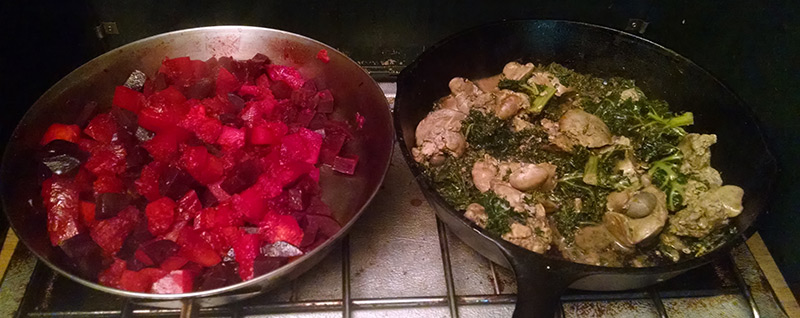 On the left are beets and butternut squash, cooked sauteed in olive oil I added chicken to this mix before serving. On the right are chicken livers and kale sauteed in olive oil. |
|||||||||
Chicken Stock & Meat Prep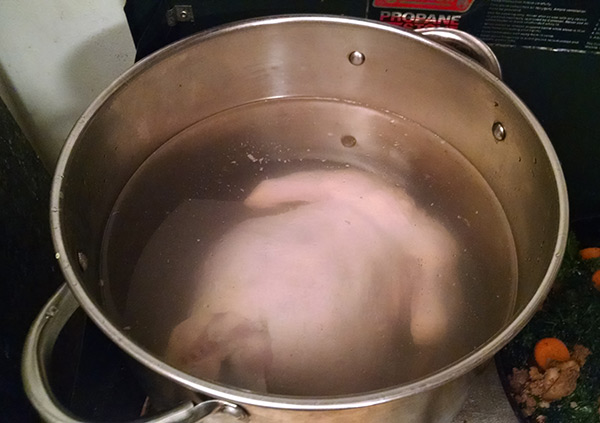 Here, I'm making over 2 gallons of chicken stock most of which will be frozen, and getting all of the meat from the chicken. The stock will last for a couple of weeks, and the chicken should last about a week. I boil it until the meat comes off the bone, then I discard the bones. I leave some of the meat in the stock, and some of it I separate to eat in my own meals and to feed the dogs. |
|||||||||
Chicken Livers with Kale, Carrots & Sea Salt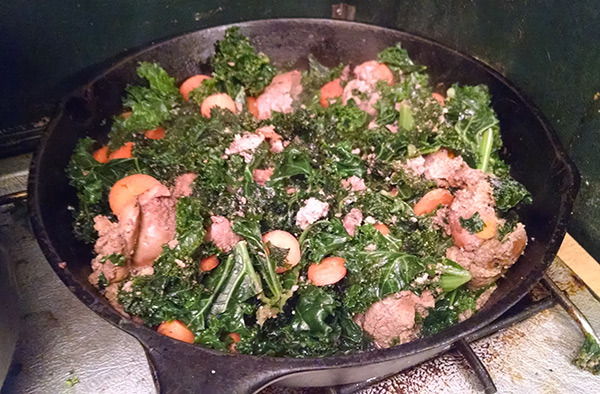 This is kale, carrots, chicken livers and sea salt. This meal will last my 35 pound dog 2 days. That's 2 cups a day for two days. To cook it, pour off the blood from the livers and feed that to the dog raw. Put the livers in a heated pan with olive oil or butter. After the chicken livers have cooked until they're grey on the outside, add vegetables, and Kale. Fill the pan with Kale until it's about 4 inches above the pan, add about 1/4 cup of water, and press a lid down on top of the Kale. Allow the water to steam the Kale and vegetables for about 7 minutes. Let cool and serve.. |
|||||||||
Black Beans & Pre-Cooked Vegetables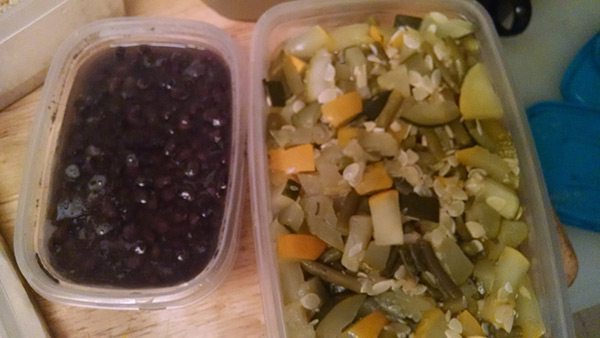 Black beans and vegetables, cooked for upcoming meals and stored separately. I added chicken or beef to these before serving. |
|||||||||
Brown Rice - Chicken Breast & Chicken Livers, Pre-Cooked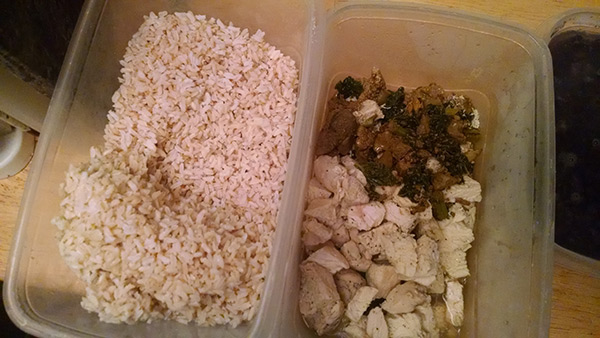 Brown rice, chicken breast and chicken livers cooked for later meals. |
|||||||||
Brown Rice, Apples & Eggs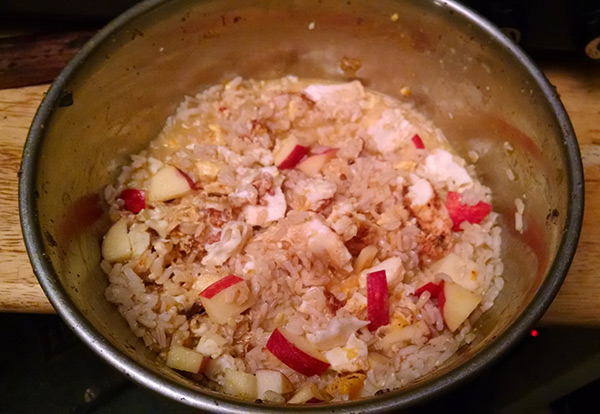 Brown rice, apples, eggs, turmeric, chia seed, ground flax seed, butter |
|||||||||
Brown Rice, Spinach & Eggs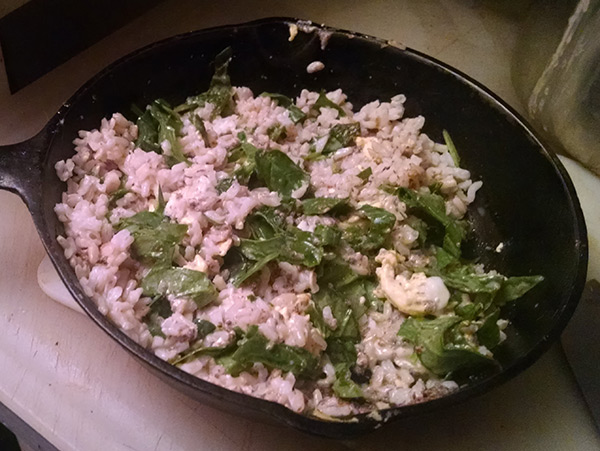 Brown rice, spinach, eggs, butter, ground flax seed, turmeric. |
|||||||||
Brown Rice, Mashed Beans & Chicken Breast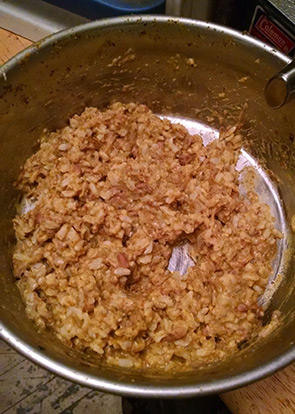 Brown rice, mashed pinto beans, kelp powder, turmeric, ground flax seed, coconut oil, served with one egg fried over easy. |
|||||||||
Brown Rice, Scrambled Eggs, Boiled Chicken & Mashed Beans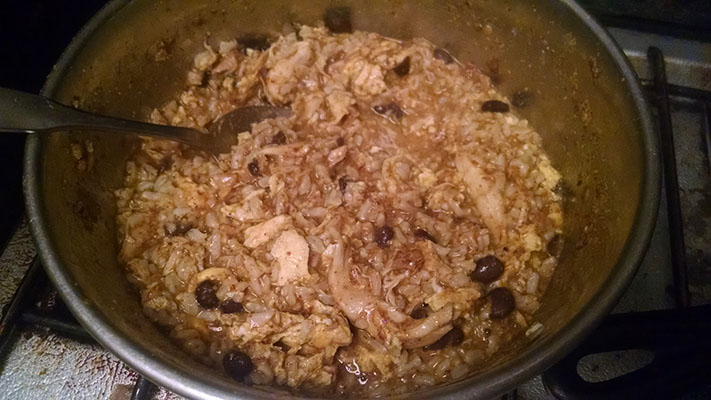 Brown Rice, 2 eggs scrambled, boiled Chicken, black beans, mashed pinto beans, chicken stock, ground flax seed, turmeric powder, chia seeds, butter |
|||||||||
Black Beans (mashed), Pre-Cooked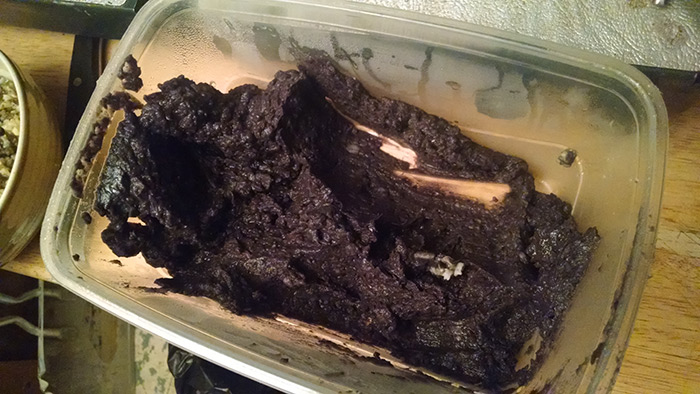 This is a container of black beans prepared for later feeding. To prepare beans, I start with dry, bagged, black beans from Wal Mart. I first check the beans for rocks, wash them repeatedly, then soak them in water overnight. I boil them on low in distilled water until they're soft enough to eat but not mushy. After they're boiled, I drain off excess liquid and freeze it or store it in the refrigerator for later use. I then grind the beans to a paste using a hand held wand type food blender. I feed a heaping tablespoon of these with a meal. If you cook more than you can use in 4 days, freeze the extra. |
|||||||||
Cooked, Canned Alaskan Salmon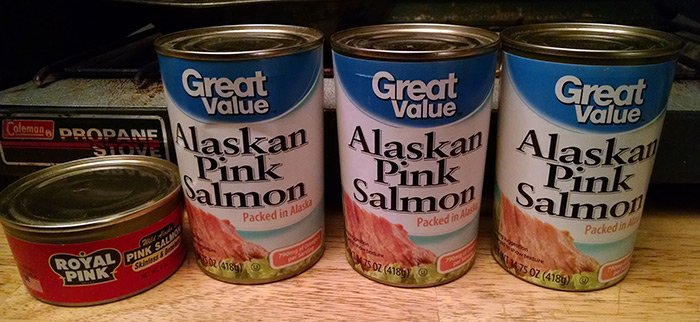 Canned fish is one of the most convenient proteins to feed. It's pre-cooked, not overly expensive and full of protein and Omega-3 oils. |
|||||||||
Salmon & Brown Rice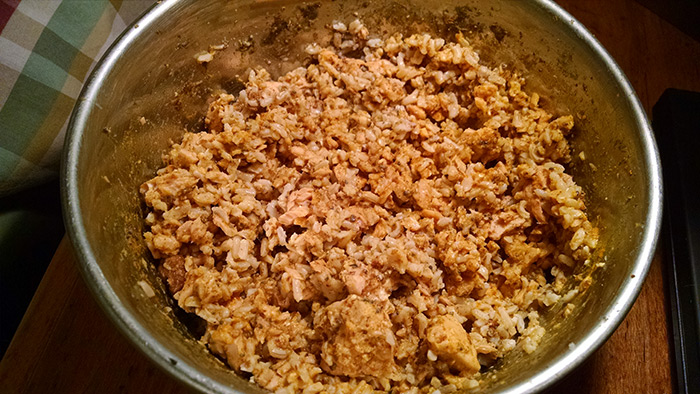 Salmon (8 ounces), with brown rice, turmeric, sea salt and coconut oil. |
|||||||||
Batch Cooking for Freezing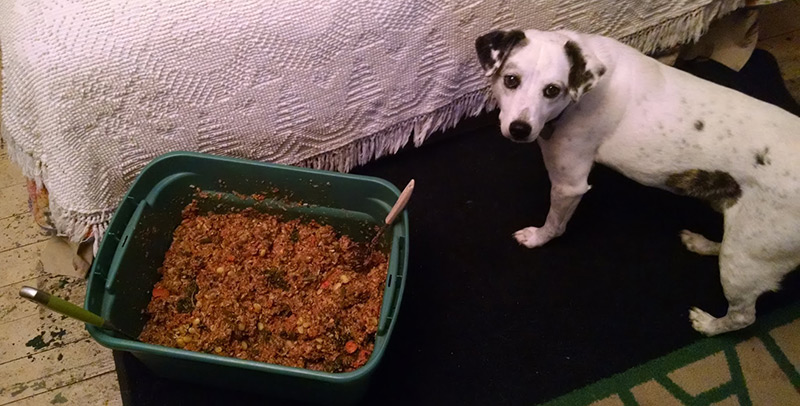 This is a batch of food I pre-prepared for freezing. It's a combination of cooked vegetables with ground beef and brown rice. |
|||||||||
Bulk Cooking for Freezing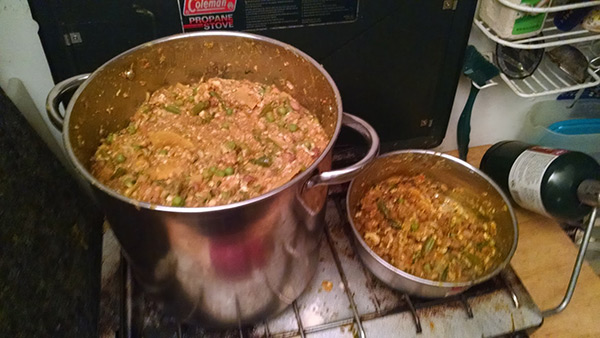 Another bulk-feeding preparation. Although the consistency of this food makes it unpalatable for me, I sometimes prepare these meals so I can eat them myself |
|||||||||
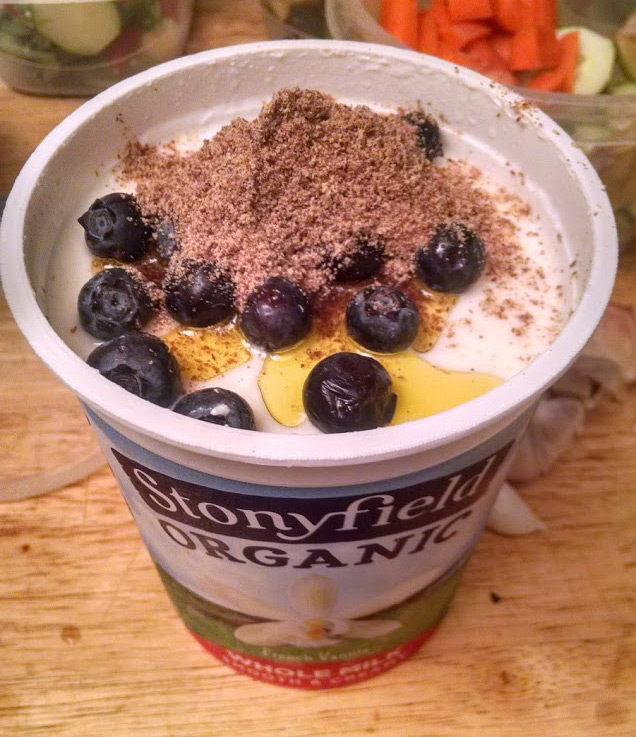
Yogurt with Fruit, Ground Flax Seed & Flax Seed Oil |
|||||||||
Frozen Chicken Stock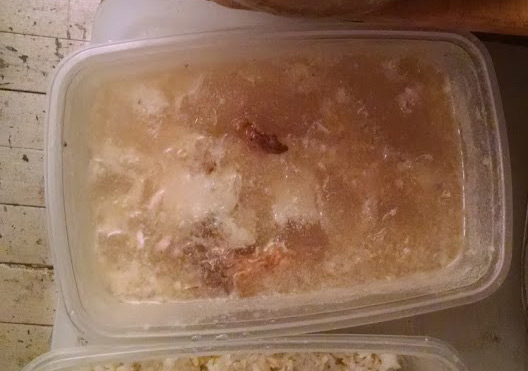 Frozen, home-made chicken broth thawing for use. You can buy chicken broth ready made, or make it yourself. I made this batch by boiling a whole chicken, removing the bones, then adding the meat back to the broth. I also use this broth in my own food. |
|||||||||
Dog Food Advisor - Dr. Mike Sagman - Dog Food Advisor has ratings of hundreds of pet foods. It's a good place to start if you want to see a rating for the dog food you're already feeding.
PET MD - Principles of Dog Nutrition - T. J. Dunn, Jr., DVM - An in-depth article on dog nutrition
Dog Food Guide - Probably more information than you will ever need about dog food, but interesting and in-depth.
What does your Dog's Vet know about nutrition? - Andrew Jones, DVM - His interesting take on how he believes most vets understand and approach nutrition, natural feeding and the influence of dog food manufacturers on dog health care. If you look deeply enough, you'll find articles claiming Dr. Jones is a self-serving huckster selling snake oil to the masses. The amount of vitriol I've seen thrown his way is interesting in its own right. The truth is probably somewhere in the middle, but this article rings true to me.
Human Foods Dogs Can and Can't Eat - The American Kennell Club - An easy to read guide to foods safe and unsafe for dogs.
What Foods are Toxic for Dogs - Canine Journal - The best list I've found of what not to feed your dog.
Pet Food (What You Need to Know) for Your Pet's Sake - Dr. Donna Spector - This article is a good primer on pet food labeling and marketing, in-depth and a good read. Dr. Spector is a board-certified veterinary internenal medicine specialist.
FDA / Recalls and Withdrawls - The FDA's current list of pet food recalls and withdrawls.
Decoding Pet Food - Adulteration, Toxic Ingredients and the best choices for your companion animals - The Cornucopia Institute - 26 pages, a bleak, in-depth and well referenced article on the pet food indsutry with descriptions and properties of additives, production methods and the laws governing pet food production.
Misunderstanding of Pet Food regulations rife on Web - David A. Dzanis, DVM, PHD, DACVN - In this article, Dr. Dzanis takes on what he believes to be misconceptions common in real food circles. Specifically, he mentioned the quote I have at the top of this document on the regulation regarding truth in labeling on dog food. By his own admission, the regulation is "admittedly vague." My take on it is that vague laws increase the margins some manufacturers use to color outside the lines. It's worth reading though as a counterpoint to the volume of noise and unfounded beliefs so common on the web.
Are Euthanized Shelter Animals Rendered for Pet Food?
EPA Document - "Emissions Factors and Policy Applications Center, Chapter 9: Food and Agriculture industries, Section 9.5.3, Introduction to Animal & Meat Products Preparation"
Around 1995 it was discovered that some dog foods contained high amounts of the barbituate Pentobarbital which is used in some animal shelters to euthanize dogs and cats. This created a firestorm of controversy which pulled in the FDA, who then did testing across a range of foods to identify the source and amount of the drug present in pet foods. They tested pet foods using a newly created method for identifying dog and cat DNA, which supposedly could detect 5 pounds in 50 tons of rendered material. The FDA says in the document listed below, "Dog Food Pentobarbital Survey Results" that while Pentobarbital is present in pet foods, that it's not sourced from animals euthanized in shelters but from stockyard animals.
This seems to be the overriding narrative throughout the pet food industry, supported by almost everyone who profits from pet food.
This document authored by the Environmental Protection Agency of the United States clearly states the opposite...
“Meat rendering plants process animal by-product materials for the production of tallow, grease, and high-protein meat and bone meal. Plants that operate in conjunction with animal slaughterhouses or poultry processing plants are called integrated rendering plants. Plants that collect their raw materials from a variety of offsite sources are called independent rendering plants. Independent plants obtain animal by-product materials, including grease, blood, feathers, offal, and entire animal carcasses, from the following sources: butcher shops, supermarkets, restaurants, fast-food chains, poultry processors, slaughterhouses, farms, ranches, feedlots, and animal shelters.”
Approximately 2.7 million dogs and cats are euthanized in the United States each year. The amount of information on the internet about this one subject is staggering. Hundreds of web pages have been written in support of each belief. After doing a lot of reading, I've found it hard to form an opinion given the conflicting information available. This issue matters to me though, and I choose to err on the side of caution.
The law allows manufacturers to use generic terms like "meat meal" and "meat by-products". Because of this, unless the label on your dog food specifically states what type of meat it contains, it's impossible to know. Source
Death by Dog Food - Kristina Fretwell Esq. - This article is not for the faint of heart. It's a "red pill, blue pill" endeavor which once read will forever strip you of your illusions about what can be in your processed dog food. The author, Kristina Fretwell wrote this paper while attending law school at California Western School of Law for the sixth annual student writing competition of the New York Bar Association and won first place. It's stark, well referenced and a bit horrifying. It takes a bit of pondering, as it's written as a legal paper, but the high points are hard to miss.
The Truth about Pet Foods and Rendering - Patty Khuly, DVM - Her take on rendering and the pet food industry and the FDA's conclusions about barbituate content in commercial dog food.
FDA / Center for Veterinary Medicine Report on the Risk from Pentobarbital in Dog Food - This is the article Dr. Khuly questions the results of in her article (above).
FDA / Dog Food Pentobarbital Survey Results - Survey #1, Qualitative Analyses for Pentobarbital Residue by the FDA
The Melamine Pet Food Recall of 2007
The FDA Report on Melamine Poisoning
This is the event that cemented the value of this diet for me, and the suspect nature of commercially produced dog food. The dog I have now, Pete, was part of a litter of 7. One of his brothers died from melamine laced dog food.
A large importer was forced to recall 837 tons of wheat gluten it sold to pet food manufacturers after it was found to be
contaminated with up to 6% melamine. Melamine is a form of dehydrated urea which is used widely in commercial products including plastics.
By some estimates, hundreds of thousands of dogs and cats died from this poisoned food. I know Pete's brother died, but not only did he die, but my friend who had him came home to find all 3 of his dogs dead. This caused huge out of pocket expenditures for emergency vet care, which would have otherwise been money saved, and even worse, caused immeasurable suffering on the part of those who lost their beloved pets, and the animals themselves.
Some safeguards have since been put in place, and most of the poisoned dog food were the cheaper varieties sold at big box stores like Wal-Mart. The real lesson for me was that ultimately, if you didn't make it, you can't trust it, and don't believe the sales hype, because it's just marketing.
I believe that in large part, most of the ailments afflicting modern dogs are caused by commercial dog food. If you really think about it, commercial dog food is what in human terms we would call "Fast Food." It's easy, it's convenient, but if you eat it every day, you're going to die young.
In 2017, Pet food sales brought in
26.69 BILLION DOLLARS in the US alone. With that much money at stake, if you love your animals, it pays to educate yourself.